Don't ever ask Gwen or me about computers, we will sit you down and explain in great detail why you need a Mac. We might even walk you to the Apple store, pick out your computer, and hold your hand while you put the money on the counter. Macs are the best computers in the world.
We run things off a G4 powerbook, which is a sweet machine. We created our whole business with it. But sometimes we ask too much of it. I'll have a graphics program open, Gwen will have the website editor going, we'll be uploading to the website server, checking email, downloading a TV show, browsing the web, and streaming audio from the net. (Here's a typical screen from a day in the life of our G4.)
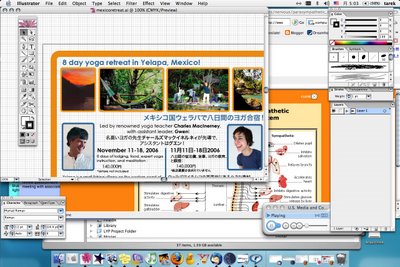
Even a Mac has trouble with all this. It gets grumpy. Things slow down, programs get stuck. So we've learned that if one of us wants to run a large program, we need to shut down any other big programs that are open to keep the computer running smoothly.
Which brings me to the point of this blog. Our bodies work in much the same way as our overworked computer. Our G4 might have a dozen programs running at any one time, from small ones like the clock in the corner of the screen to the really obvious ones like Microsoft Word. Well, at any one time your body is doing literally thousands of things. Think about it for a moment, your eyes are taking in the writing on the screen, your brain is giving meaning to the writing, your mouth is producing saliva, your inner ear is sending signals to keep you upright, your lungs are respiring, your heart is pumping, your stomach is digesting, your kidneys and liver are filtering, your intestines are moving material, your pancreas is, umm... pancreasing... you get my point.
So let's imagine a situation in which you need to run a "big program," something beyond the body's usual functions. The classic example here is encountering a wild animal, but when is that last time anyone did that? I prefer something we can all relate to, let's use as our example walking down a dark street at night, and noticing that you are being followed.
You know the feeling well... your hairs stand on end, your muscles tense, your breath gets short, your heart races, and you have a surge of energy and hyper-alertness. It's the much talked about "fight or flight" response.
But what's really happening here? Well, your body is doing exactly what we do when we need to run a big program on our computer. We open the programs we need for the task at hand and close the programs that we don't need for that job. (For example, if I need to open Adobe Illustrator and work with graphics, I will also open iPhoto to have easy access to our photos, but I will shut down our FTP uploading program, because there won't be anything to upload until the graphics are done, and I can use that RAM for other things.) Pretty obvious right? Turn on the stuff you need, shut down the stuff you don't need.
Now, back to that dark alley where you're being followed. For this situation, what do you need?
- Alertness: the sight of the bad guy sets off the locus coeruleus region of your brain, which makes your senses hyper-fast, like in the Matrix.
- Energy: Adrenaline cranks up the heart rate and blood flow.
- Fuel: Norepinephrine is released by the brain into your involuntary nervous system, hiking up your blood pressure and breathing rates (giving you the fuel of fresh blood and fresh air.) At the same time Cortisol hits the liver and produces glucose, a sugar that can be used by the muscles and brain for short term bursts of energy.
Now, during this life or death situation, what do you
not need to do?
- Digest dinner: That same Cortisol that spikes your glucose levels shuts down the digestive actions of the stomach.
- Pass food: The rectum contracts.
- Fight disease: We're worried about the next five minutes here, not the next 5 years! Shut off that immune system for now!
- and many, many, more...
All of this happens in a matter of seconds. Your body is jerked from its natural chemical levels (homeostasis) into a revved up, ready to kill or be killed state. Heart racing, you stop, turn to face your attacker in the alley...and... see a tired businessman fumbling with his keys, getting into his car parked on the corner, and driving away.
Phew! Lucky, right? Maybe not. Let's take a look at the state of your body now. Your heart rate is high and will take a few minutes to get back to normal, you have lactin and glucose sloshing around in your body that was never burned up. Your stomach has to start the digestion process all over again, and your immune system is suppressed. And with all that extra adrenaline in your blood you probably won't be getting a good sleep tonight.
If this only happened on dark streets at night, it probably wouldn't be a big deal, but we modern humans have very little skill at separating what are real crises, and what is a
manufactured stressor, like a report, an important meeting, a problem in the family, or a test. We respond to these everyday incidents with the same chemicals that we used to respond to wild animals with. There is an important difference however. Our ancestors actually did some fighting or flying, using the systems that the body developed. We don't. And the effects accumulate over time. Among them, muscle tension, headache, indigestion, ulcers, and disease. There are other side effects as well. If your body is constantly being told it needs to be ready to flee, it will want to stock up on short term energy boosting foods with high carbs and fat (McDonalds anyone?). And if you can't unwind after repeated "fight or flight" incidents, you will be tempted to "come down" using external depressors, alcohol, drugs, excess TV, etc... All of this leads scientists to state that 90% of all disease is caused by stress.
And this is where the analogy of our poor overworked laptop breaks down. If we push our Mac too hard and the screen goes black one day, we can get another computer. But your body, that's an irreplaceable, one of a kind model.
How can we take better care of it? Well, one way to deal with all those stress chemicals floating around in your body is to burn them off with exercise. This takes care of the worst side effects of over-stress and is definitely recommended. It took 50 years for people to really get the message that exercise is not just good, but necessary for a healthy life.
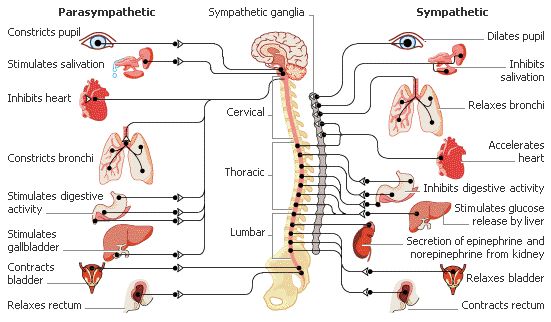
But there is more to the story! Are you satisfied with a life of simply being "not sick?" No way! You want to feel great right! Luckily for us life is not all about "fight or flight." There is a whole other nervous system in your body, one that we can call "rest and relax." (The technical terms for these two systems is the sympathetic and parasympathetic nervous systems, but no one can ever keep straight which is which!) The rest and relax system does just the opposite of the fight or flight system. The heart rate slows, the bowels and musculature relax, the immune system is boosted, and calm, clear thinking is possible. Here is a helpful graphic from this
great website that illustrates the difference between the two systems.

The trouble is that Westerners never became very good at actively engaging the rest and relax response. But it turns out that some wise people on the Indian subcontinent did, and passed on the gifts of yoga and meditation to the world.
I have tried to keep my facts all based in science up till now, but these investigations into how yoga and meditation affect the body are still in their infancy, and solid figures are hard to come by. But every single study I've read shows that doing these practices lowers stress, boosts the immune system, and helps you live longer. In 20 years this will probably be accepted as the most obvious fact, just as we accept that a balanced diet and daily exercise are key to good health now.
If you've read this far, you must be interested! So I beg you to take that extra step for yourself, find a yoga class and meditation program near you, and get started! And if you're already doing these things, trust that they are helping you not just today, but long into your future. You won't regret it.
Uh oh, my laptop is starting to make a funny noise, I better end it here!
Patrick
Yoga GardenIf you're in business and want to know more about how stress affects you check
this article out.
And how could I neglect to link to
this site!
 As you may know we have a small reed fence on the studio veranda, and as I sat with it in front of me I noticed that the strips that hold it to the rail really needed to be clipped. You could see the ends of them hanging out over the balcony and it just didn't look well put together. The only problem was that it would be really hard to reach them. Once before I tried standing on a footstool and leaning over the rail but it felt pretty dangerous with half my body hanging out over the edge. The other option would be to climb over the fence and stand on the little outside ledge, that way it would be easy to clip the strips, but I would have to keep one hand on the rail at all times. Perhaps I could tie myself to it in case I lost my grip?