Showing posts with label yoga. Show all posts

Tuesday, August 21, 2007

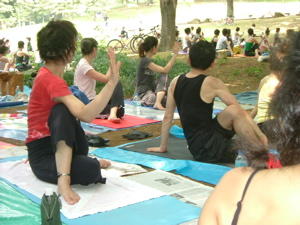
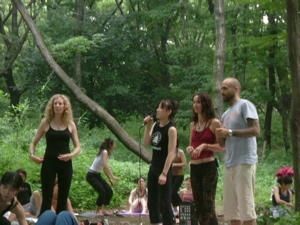
Yoga in Yamashita Park

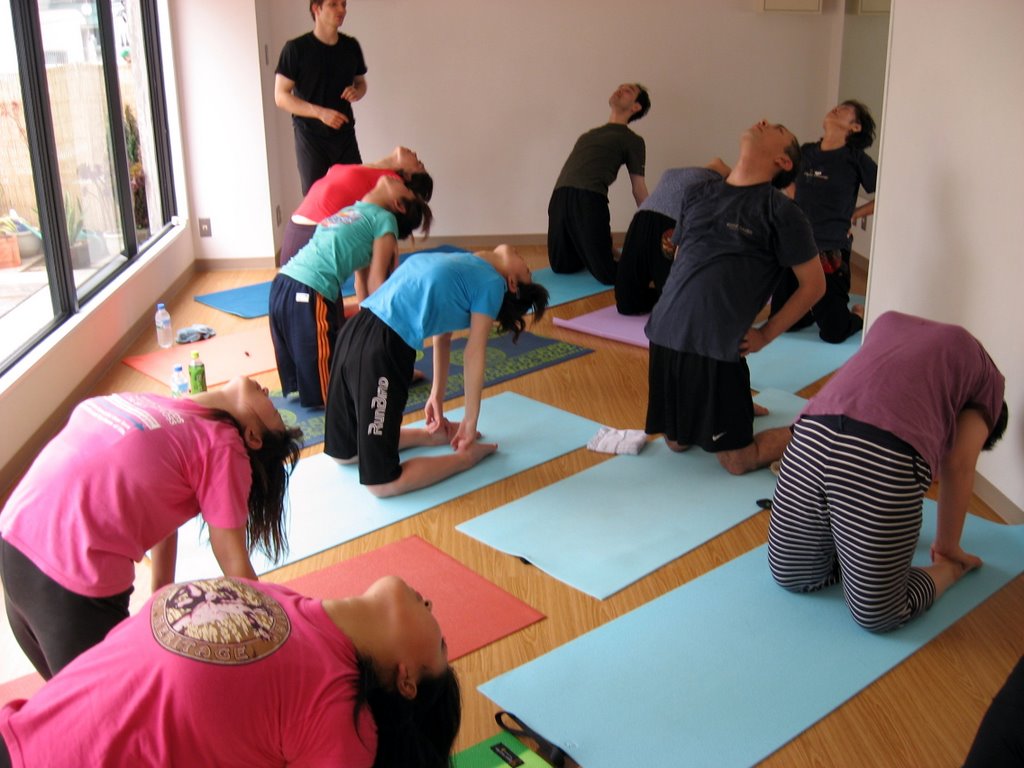
Thanks to everyone who came out early to enjoy the earth and sky at our yoga in the park event. It was so popular we'll do it again next month! Check the homepage for information!




Yoga Garden

Thursday, July 05, 2007

Thanks For a Great Event!

Hi everyone, I just wanted to say thanks for all the people who came out this July 1st to celebrate 2 years of Yoga Garden! I'll let the pictures do the talking!


And if you're interested we made this short video on the veranda after the event!

-Patrick

Yoga Garden

Saturday, January 27, 2007

My Thoughts After the Chakra Workshop

I'm not sure when this change started happening to me, but every year I am becoming less concerned about what is true, and more interested in what is right.

Today we had a Chakra Workshop at the studio, and I eagerly attended, as I don't know much about that aspect of yoga and Indian spirituality.
I know a little more now, and I will try to explain it, in the absolutely non-technical and poorly referenced style that drives my discussion group members crazy in my graduate school program.

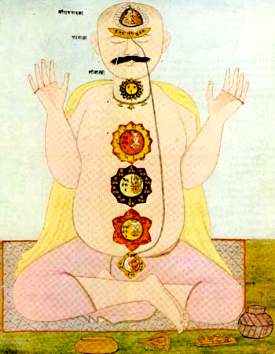
According to the Indian tradition, our bodies are kind of conduits of energy. Energy is divided into two types, the cool, feminine, moon type, and the hot, masculine, sun type. In our bodies these two wavelengths of energy come together in 7 places.

The interaction between the two energies creates a swirling wheel (actually a funnel) of concentrated energy. In Sanskrit the word for wheel is cakra, which, which over time becomes Chakra.

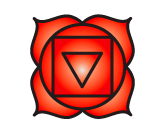
The 7 Chakras each have a different area of the body, mind, and spirit, to take care of. For example, the base Chakra...
...has to do with our basic survival and security instincts, while a few Chakras up the Heart Chakrais the agent of love, compassion and healing. (If you want to know more about the exact function of each chakra, you can check this excellent site out)
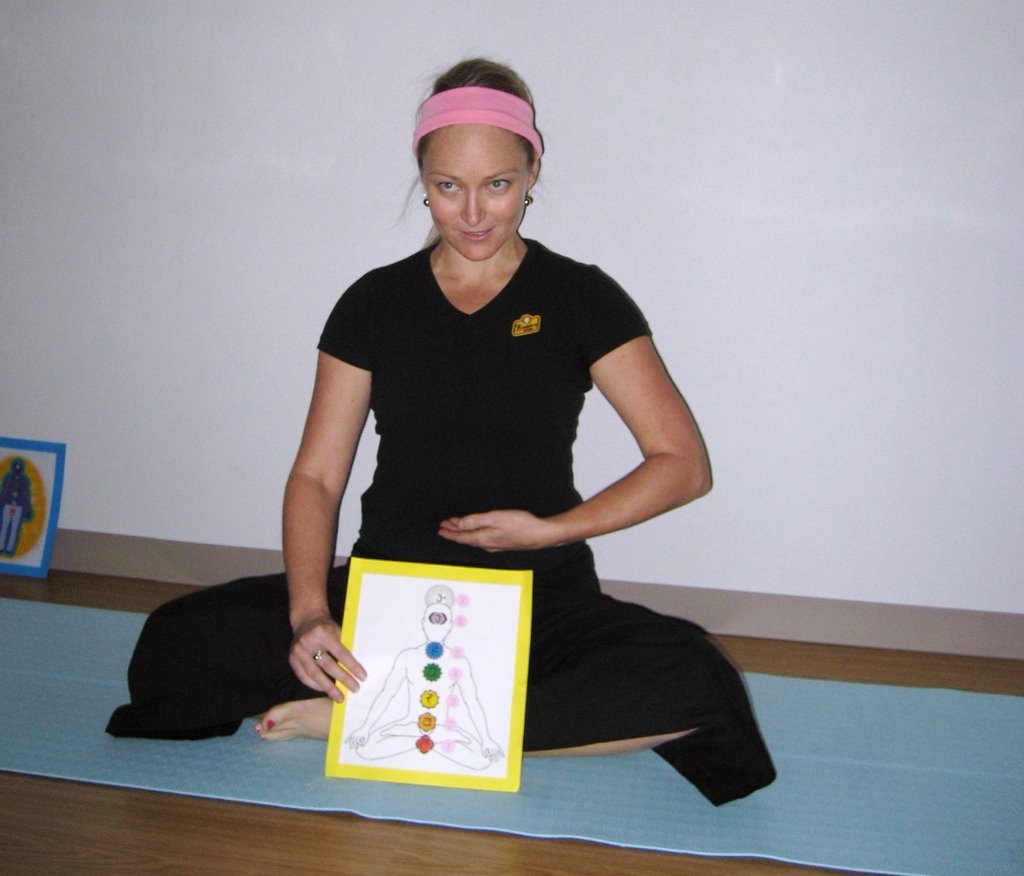
With stress, unresolved emotions, poor diet, bad habits, etc... one or more of the Chakras can become "blocked", I guess meaning it doesn't conduct the energy very well. So, if you're having trouble saying what you mean, your throat Chakra might be out of wack.

And that's only the preamble. If you succeed in really opening all of your Chakras, through a variety of methods you can begin to tease out your spirit's true power, which is visualized as a coiled snake at the base of your spine. This is the famous Kundalini energy, which if you can get it up through all the Chakras (it gets harder the higher you go) will unite you with the universe, the Brahman.

Here's Shanel explaining all this much better than me. Thanks for an awesome workshop Shanel!)

I am a very skeptical person by nature , and I'm not at all sure that I have spinning funnels of energy inside me. The Chakra system has a number of things which we could point out as nonsensical and inconsistent. And a few years ago I might have taken a kind of cynical delight in doing just that.

But the more I learn about these ancient systems the more overlap I'm seeing. Here for example, are two images of the Chinese Grand Chi Circulation system. This one goes down the body towards the tip of the spine...

And this one goes up to the top of the head...

According to the Taoist idea, our life force (chi) leaks out in our day to day activities, and when our supply is gone, we kick the bucket. But by learning to draw the chi up from the base of the pelvis and back towards the crown of the head we can conserve this resource and have happier healthier lives.

Here we have two highly advanced ancient cultures, operating thousands of miles away from each other, who come up with a system of alternating energies (in the Chakra system, Ida/Pingala, in Taoism, Yin/Yang) which conduct the essential energy (prana/chi) of the universe. Furthermore, this energy can be coaxed up through the spine area for better health.

I spend about 20 hours a week teaching, studying, and doing yoga and meditation, which makes me something of an "expert" in our world. But the people into this stuff in old India and China might spend 20 hours a day on it. And I'm going to tear down these ideas because I've read some science books and a Wikipedia article? No way man.

But more importantly, at today's workshop, the Chakra system totally worked for some of the students. Using it they were able to come closer to themselves, to relax, and to heal. For others it's tai chi, still others find that in a pew at church, or on a prayer mat facing Mecca. For me it's on a meditation cushion looking a wall. And, when you really think about it, these things are all ridiculous, but that doesn't make them any less right. We're all trying to make sense of the world, and in the end I think that all of these practices are metaphors pointing to the same thing.

This is a lesson I am glad to have learned. Because running around trying to prove everyone else wrong is exhausting!

Thanks to all who attended the workshop!
Patrick

Yoga Garden

Here are some other websites that made getting all my facts straight for this blog much easier:
http://www.kheper.net/topics/chakras/chakras.htm
shivasakti.com

Tuesday, August 01, 2006

Our Message of Peace

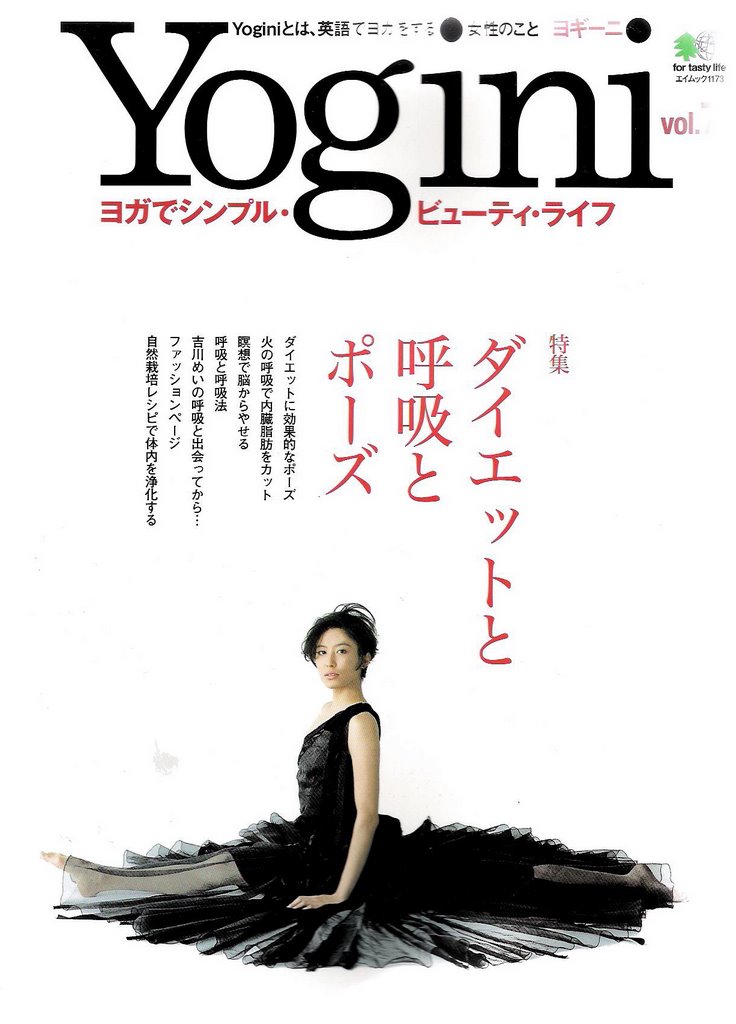
Check out the summer issue of Yogini, you might see some friendly faces somewhere in there!
Yep, that's us! The magazine asked us to design and make a T-shirt with our message of peace for the world. Gwen and I knew almost immediately what our message would be.

Be Peace

"Be Peace" is so simple and catchy that it runs the risk of just sounding like a new-age catchphrase, along the lines of "be here now" or "it's all one, dude." I had an English professor who said that the best poems are those that are bigger on the inside than on the outside, and I think this phrase is the same.

Before I go on, please go to this site and watch the video if your computer can play flash. It is a short feature with narration by Thich Nhat Hanh and his philosophy about being peace. Thich Nhat Hanh is the one who taught us this phrase and despite our efforts we couldn't give him a shout out in the Yogini article.

I think that almost anyone you ask will say that they want to change the world for the better. It's easy to get wrapped up in the activist parts of improving the world, things like signing peace treaties, building wells with clean water, destroying nuclear weapons, or protecting the environment. At my university it was almost impossible to walk across campus without getting a leaflet about how you could join a protest, sign a petition, or boycott a product. These things are certainly good, but from a buddhist perspective, not very important.

Buddhism is strange like that, things are always opposite of what you expect. All these things we try to do to bring peace into the world will not be much help unless we are peaceful within ourselves.

When I was an aid worker I noticed that the volunteers who enacted the most long lasting change in their communities were the ones who seemed to have themselves sorted out. Many people, including myself, tried to just push projects through, and the results were never pretty. Maybe I will go into it more in another blog, but basically a project that required a lot of doing by the volunteer ended up neglected, misunderstood, and ultimately unsuccesful. However, there were some volunteers, who had something that made their communities trust and respect them. It was something that translates across languages and cultures, and that is a solid, quiet, sense of inner peace. Volunteers who were really there in the community, not running around trying to fix everything, got so much more done! And it didn't require a lot of outward effort. They didn't make peace, they were peace.

We can't all go do aid work in Africa, nor do we need to. A peaceful person spreads peace to every person they encounter, just as an angry person spreads ill will. So if you are the kind of person that wants to make positive change in the world, forget all those protests and petitions for a while, and concentrate on really being ok with yourself. Yoga and meditation will help! But the most important thing is to appreciate the moment you are in and the people you are around, without striving to make things the way you think they should be. That's the definition of peace, and it's not something you can do, it's something you can BE!

Peace,
Patrick


Yoga Garden

Saturday, July 08, 2006

One Year On

This July 1st Yoga Garden turned one year old. We had a big "all you can stretch" event. I think some of the braver souls got more than 3 hours of yoga in! It was a lot of fun, and we want to send a big thanks out to everyone who came.

I've been thinking about what we learned in our first year of having the studio. Here are a few of the life lessons of 2005/2006. Some came naturally, some we learned the hard way, and some we're still figuring out. Here goes...

Don't give up! A lot of people will tell you something can't be done, until you do it. Then everyone acts like it was meant to be.

Listen to people. Usually 5 minutes of listening will help someone more than 25 minutes of you talking to them.

You are your community. Sometimes it's not enough to search for people who are on the same path as you. You have to carve that path out of the jungle and recruit a team to follow you in.

Keep it simple. Life is complicated enough. Whenever possible offer clear choices and real answers.

Knowledge is not a limited resource. Everyone loves to learn, if you have some knowledge that is useful for others, share it freely. The rewards will come back to you in one way or another.

Listen to Gandhi. He said, "Happiness is when what you think, what you say, and what you do are in harmony." Find a job that gets you closer to that sentence. Happiness is much more valuable than a big salary.

Stop paying too much for a haircut. You can get a really good one for 1000 yen! Girls too!

Learn things by doing things. Put yourself in situations where you must grow or you will fail. Faced with this choice, you will almost never fail.

Listen to your body. If you're tired, sleep, if you're working too hard, relax. Not much is important enough to neglect your one and only body.


Calorie Mate is not a food group.

Listen to Mark Twain. "I am an old man and have known a great many troubles, but most of them never happened." Don't devote your energies to all the "what if" scenarios. Most of them never happen. Stay in the present and react to life with a fresh, nimble mind.

To all of our customers, friends, and family.
Thank you for a great year!
Patrick

Yoga Garden

Monday, June 26, 2006

How Stress Works

Don't ever ask Gwen or me about computers, we will sit you down and explain in great detail why you need a Mac. We might even walk you to the Apple store, pick out your computer, and hold your hand while you put the money on the counter. Macs are the best computers in the world.
We run things off a G4 powerbook, which is a sweet machine. We created our whole business with it. But sometimes we ask too much of it. I'll have a graphics program open, Gwen will have the website editor going, we'll be uploading to the website server, checking email, downloading a TV show, browsing the web, and streaming audio from the net. (Here's a typical screen from a day in the life of our G4.)
Even a Mac has trouble with all this. It gets grumpy. Things slow down, programs get stuck. So we've learned that if one of us wants to run a large program, we need to shut down any other big programs that are open to keep the computer running smoothly.
Which brings me to the point of this blog. Our bodies work in much the same way as our overworked computer. Our G4 might have a dozen programs running at any one time, from small ones like the clock in the corner of the screen to the really obvious ones like Microsoft Word. Well, at any one time your body is doing literally thousands of things. Think about it for a moment, your eyes are taking in the writing on the screen, your brain is giving meaning to the writing, your mouth is producing saliva, your inner ear is sending signals to keep you upright, your lungs are respiring, your heart is pumping, your stomach is digesting, your kidneys and liver are filtering, your intestines are moving material, your pancreas is, umm... pancreasing... you get my point.

So let's imagine a situation in which you need to run a "big program," something beyond the body's usual functions. The classic example here is encountering a wild animal, but when is that last time anyone did that? I prefer something we can all relate to, let's use as our example walking down a dark street at night, and noticing that you are being followed.
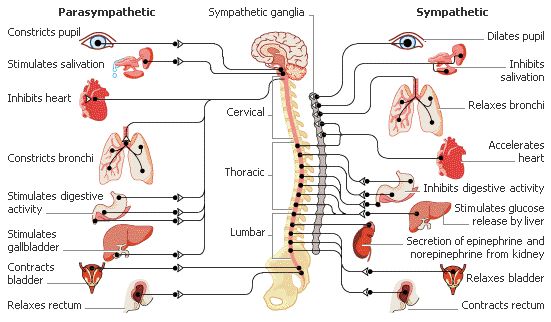
You know the feeling well... your hairs stand on end, your muscles tense, your breath gets short, your heart races, and you have a surge of energy and hyper-alertness. It's the much talked about "fight or flight" response.
But what's really happening here? Well, your body is doing exactly what we do when we need to run a big program on our computer. We open the programs we need for the task at hand and close the programs that we don't need for that job. (For example, if I need to open Adobe Illustrator and work with graphics, I will also open iPhoto to have easy access to our photos, but I will shut down our FTP uploading program, because there won't be anything to upload until the graphics are done, and I can use that RAM for other things.) Pretty obvious right? Turn on the stuff you need, shut down the stuff you don't need.
Now, back to that dark alley where you're being followed. For this situation, what do you need?

  • Alertness: the sight of the bad guy sets off the locus coeruleus region of your brain, which makes your senses hyper-fast, like in the Matrix.
  • Energy: Adrenaline cranks up the heart rate and blood flow.
  • Fuel: Norepinephrine is released by the brain into your involuntary nervous system, hiking up your blood pressure and breathing rates (giving you the fuel of fresh blood and fresh air.) At the same time Cortisol hits the liver and produces glucose, a sugar that can be used by the muscles and brain for short term bursts of energy.

Now, during this life or death situation, what do you not need to do?

  • Digest dinner: That same Cortisol that spikes your glucose levels shuts down the digestive actions of the stomach.
  • Pass food: The rectum contracts.
  • Fight disease: We're worried about the next five minutes here, not the next 5 years! Shut off that immune system for now!
  • and many, many, more...
All of this happens in a matter of seconds. Your body is jerked from its natural chemical levels (homeostasis) into a revved up, ready to kill or be killed state. Heart racing, you stop, turn to face your attacker in the alley...and... see a tired businessman fumbling with his keys, getting into his car parked on the corner, and driving away.
Phew! Lucky, right? Maybe not. Let's take a look at the state of your body now. Your heart rate is high and will take a few minutes to get back to normal, you have lactin and glucose sloshing around in your body that was never burned up. Your stomach has to start the digestion process all over again, and your immune system is suppressed. And with all that extra adrenaline in your blood you probably won't be getting a good sleep tonight.

If this only happened on dark streets at night, it probably wouldn't be a big deal, but we modern humans have very little skill at separating what are real crises, and what is a manufactured stressor, like a report, an important meeting, a problem in the family, or a test. We respond to these everyday incidents with the same chemicals that we used to respond to wild animals with. There is an important difference however. Our ancestors actually did some fighting or flying, using the systems that the body developed. We don't. And the effects accumulate over time. Among them, muscle tension, headache, indigestion, ulcers, and disease. There are other side effects as well. If your body is constantly being told it needs to be ready to flee, it will want to stock up on short term energy boosting foods with high carbs and fat (McDonalds anyone?). And if you can't unwind after repeated "fight or flight" incidents, you will be tempted to "come down" using external depressors, alcohol, drugs, excess TV, etc... All of this leads scientists to state that 90% of all disease is caused by stress.
And this is where the analogy of our poor overworked laptop breaks down. If we push our Mac too hard and the screen goes black one day, we can get another computer. But your body, that's an irreplaceable, one of a kind model.
How can we take better care of it? Well, one way to deal with all those stress chemicals floating around in your body is to burn them off with exercise. This takes care of the worst side effects of over-stress and is definitely recommended. It took 50 years for people to really get the message that exercise is not just good, but necessary for a healthy life.
But there is more to the story! Are you satisfied with a life of simply being "not sick?" No way! You want to feel great right! Luckily for us life is not all about "fight or flight." There is a whole other nervous system in your body, one that we can call "rest and relax." (The technical terms for these two systems is the sympathetic and parasympathetic nervous systems, but no one can ever keep straight which is which!) The rest and relax system does just the opposite of the fight or flight system. The heart rate slows, the bowels and musculature relax, the immune system is boosted, and calm, clear thinking is possible. Here is a helpful graphic from this great website that illustrates the difference between the two systems.
The trouble is that Westerners never became very good at actively engaging the rest and relax response. But it turns out that some wise people on the Indian subcontinent did, and passed on the gifts of yoga and meditation to the world.
I have tried to keep my facts all based in science up till now, but these investigations into how yoga and meditation affect the body are still in their infancy, and solid figures are hard to come by. But every single study I've read shows that doing these practices lowers stress, boosts the immune system, and helps you live longer. In 20 years this will probably be accepted as the most obvious fact, just as we accept that a balanced diet and daily exercise are key to good health now.

If you've read this far, you must be interested! So I beg you to take that extra step for yourself, find a yoga class and meditation program near you, and get started! And if you're already doing these things, trust that they are helping you not just today, but long into your future. You won't regret it.
Uh oh, my laptop is starting to make a funny noise, I better end it here!
Patrick

Yoga Garden

If you're in business and want to know more about how stress affects you check this article out.

And how could I neglect to link to this site!

Sunday, June 11, 2006

Interview with Kazuhiro Ono

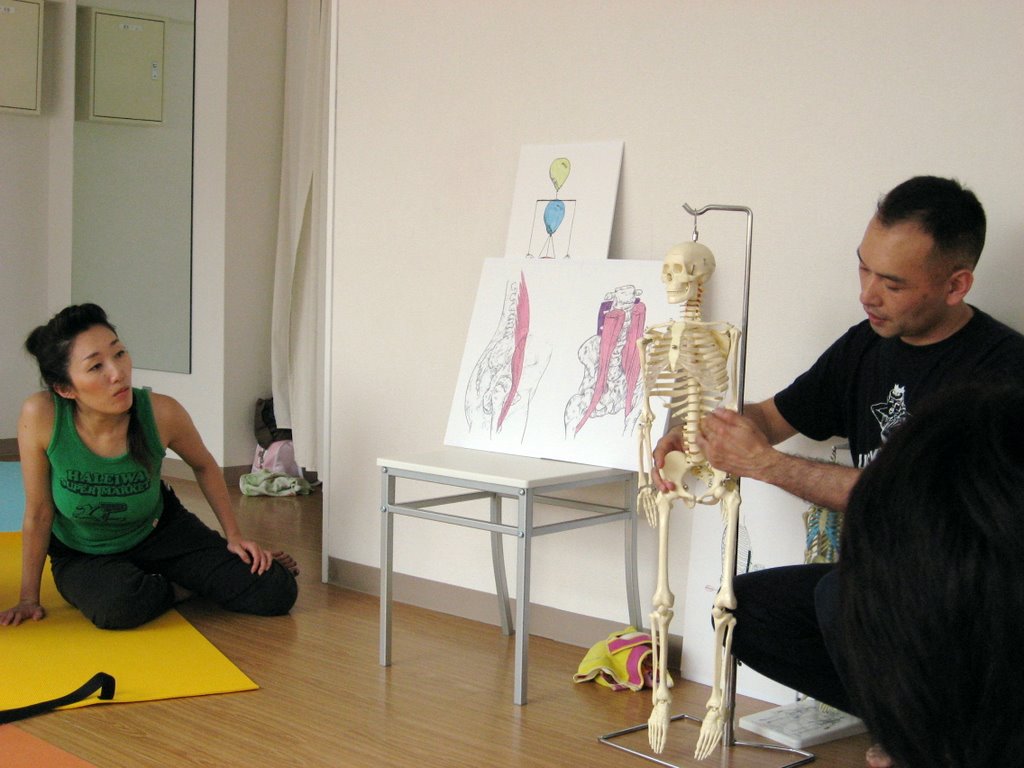
This weekend, certified Rolfer Kazuhiro Ono gave his "Mechanics of Movement" workshop at the studio. We had a big turnout and everyone learned a lot about how to use their bodies more efficiently. The session began with a discussion of the diaphram and how to use it to get the most from each breath. Next we moved on to healthy walking by using the psoas muscle. Kaz gave us a lot of small exercises we can do to improve these fundamental functions. I'll write a blog in the near future that will illustrate these exercises for you!
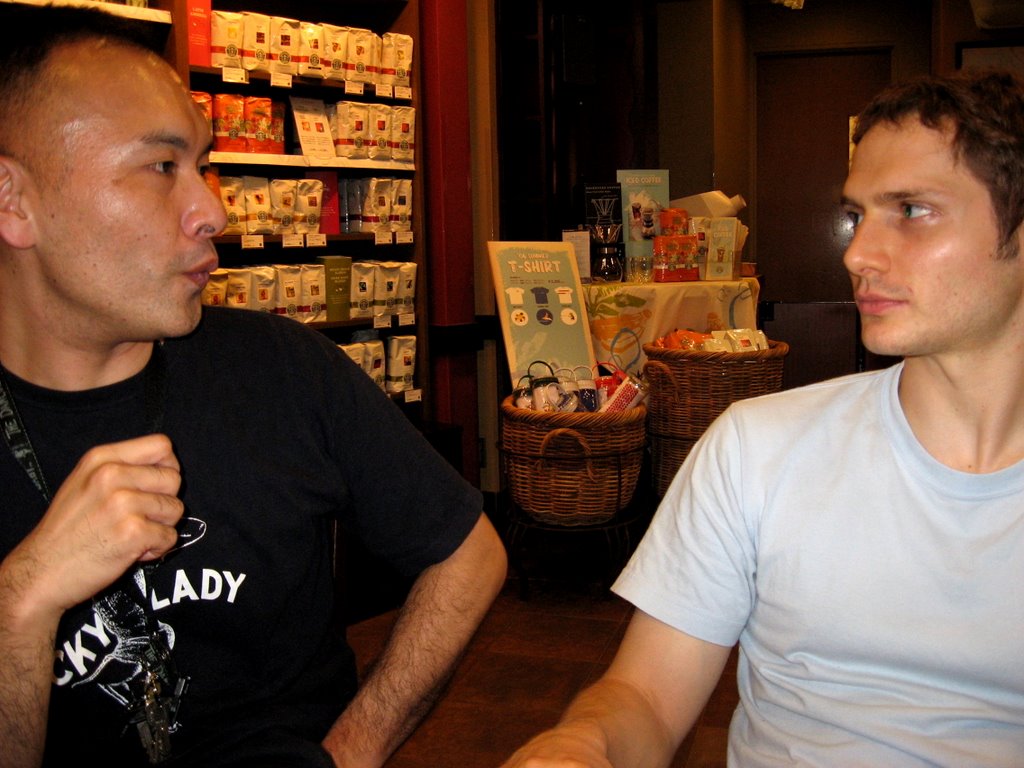
After the workshop we went to a cafe and had an informal interview with Kaz. Here are some excerpts from it. He's a really interesting guy!

Yoga Garden: You used to be a manager for a home construction company. Why did you change to a career in health?
Kaz: I had a proffessor in university who told our class that we should go into one of three fields, clothing, food, or housing, because those are three things that people will always need. I went into housing with the construction company, but I started to think that there was an even more important thing for life, your health. Which is more important for you, a nice house, or your health? Also, I didn't like working for a company. I don't like to have a boss, and I don't like to be the boss.
YG: There are many kinds of health therapies, why did you choose Rolfing?
Kaz: Most forms of massage focus on the body one area at a time, the shoulders, or the feet, for example. I was interested in changing the whole structure of the body, for a long term effect. So I chose Rolfing.
YG: How exactly does Rolfing help people?
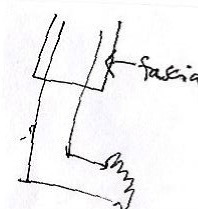
Kaz: All of our muscles are surrounded by a thin layer of tissue. This is the fascia. If you ever buy a piece of uncooked chicken, you can see the fascia, it is the thin white covering over the meat. Over time, the fascia becomes tight and locked up. Right now you are wearing a T-shirt. Imagine the muscle is your arm, and the sleeve of your T-shirt is the fascia. (Kaz sketches this picture on an envelope)
If I hold your sleeve very tightly around your arm, it's hard to move your arm isn't it? It is the same for fascia that is locked up. With strong pressure, the fascia can be loosened up, which allows your posture to improve, and your movements to become smoother, and more efficient.
YG: Can a person feel their own fascia?
Kaz: It takes a little practice, but you can feel your fascia. Someone told me that if you press on your skin with as much pressure as it would take to squish an ant, that's the point where you are making contact with the fascia, but I don't know if that's true, I never tried really squishing an ant!
YG: The pressure used in Rolfing can be painful, right?
Kaz: Sometimes, especially problem areas in the fascia, where there are a lot of nerve endings, can be painful. I do not enter the patient's boundary of too much pain, however. There is usually another way to work with that area that is less uncomfortable.
YG: Do you have some clients who are skeptical about the benefits of Rolfing?
Kaz: Yes, once that happened. A client said he couldn't feel any changes in his body after a session. That's ok. I didn't mind, because I could see the changes in him. But almost all of my clients feel a big difference after just one Rolfing session.
YG: How can Yoga and Rolfing work together?
Kaz: Since I started doing yoga with you guys, I have noticed that my movement has improved a lot. So maybe Rolfing can prepare the body structure for more efficient movement, and yoga can teach that efficient movement. I see some yoga students having trouble with balancing poses, like tree pose, and I think that if their structure was improved, they would have an easier time with that pose. There are many connections between Rolfing and yoga, I think. We have to discover them together!

Thanks Kaz, for a great workshop! If you're interested in learning more about Rolfing, check the Rolfing Institute homepage, or Kaz's homepage here. We had such a good time doing this workshop that we want to arrange "Mechanics of Movement, Part 2" in the coming months. The second workshop will focus on the two girdles, shoulders, and pelvis. Keep checking the workshop homepage for more information.

Patrick

Yoga Garden

Tuesday, May 30, 2006

Fight!

Last week Gwen and I were sitting in a cafe, mapping out the summer and fall events at Yoga Garden. We had snagged one of the elusive window seats with the big chairs, looking out at an intersection near city hall. Gwen saw this first, and from what we pieced together after this is what happened.
A salaryman was waiting at the corner for the light to change, and another guy in a windbreaker on a bicycle clipped the salaryman. The salaryman started yelling at the windbreaker guy, and kicked the bicycle. The windbreaker guy cuffed the salaryman on the back of the head, and at that moment the salaryman sensed this guy was a loose cannon and walked away cursing. The windbreaker guy threw his bicycle to the ground and stalked after the salaryman with a murderous glint in his eye. At that point they had walked out of the sightline of the window to the sidewalk in front of the building.

Gwen and I had a choice then, although things happened so quickly we didn't really recognize it as that. The incident had happened outside, through a window, and the two men were now in the front of the building, where there were about 20 other cafe customers, a park, and a busy sidewalk. It was out of our hands, right?

If you've spent any time in a psychology class you'll have heard of the "bystander effect." The idea is that in an emergency situation where someone is in danger, the more people that are around, the less likely that anyone will help that person. There are many famous (and sad) cases, where someone is attacked in a very public place (an apartment buildings front steps, on a busy bridge) and no one stops to help or even call the police. I had a psychology teaching assistant, who once, in the middle of the lecture, was suddenly attacked by another teacher. The attacker threw him to the ground and they kicked and fought their way out into the hall. In our lecture room of about 100 people, no one moved a muscle, we were frozen in our seats. The teaching assistant came back in a few minutes later and revealed that it had all been an act, and that frozen, "what's going on?" feeling was the bystander effect. This effect happens to everyone, no matter how "good" or "brave" a person you are.

But what was interesting in this story is that Gwen and I didn't really think about it, and went into action. I went to the front of the building while Gwen got the staff to call the police. Out on the sidewalk, the windbreaker guy had just caught up to the salaryman, and all the cafe patrons were watching them swear and scream at each other. The windbreaker guy suddenly grabbed the salaryman by the throat, threw him into a bush, and was squeezing his windpipe with one hand and strangling the salaryman with his own tie with the other! I ran over to them and pulled the windbreaker guy off the salaryman, but his grip on the necktie was so tight that all three of us kind of lurched out of the bush. I told the attacker to relax, that it was a small problem, nothing to get upset about, and peeled his fingers off the necktie. The two men were eerily quiet, just staring at each other with hatred. I was afraid to let go of them, or they might start trying to kill each other again. The police arrived shortly and broke it up, took all of our statements, and that was that.

I was thinking about it later, about how it had been a perfect example of the bystander effect. There were a dozen people closer to the guys than we were, but no one else moved a muscle, just like that psychology class. What made Gwen and I act so decisively? Neither of us is particularly brave or eager to "save the day," and we don't even speak Japanese that well, especially all that emergency vocabulary that you should learn but never bother to. Like everyone else there, we just wanted to relax and enjoy our coffee. What I concluded is that the difference between us and the rest of the crowd there is that we do a lot of yoga and meditation.

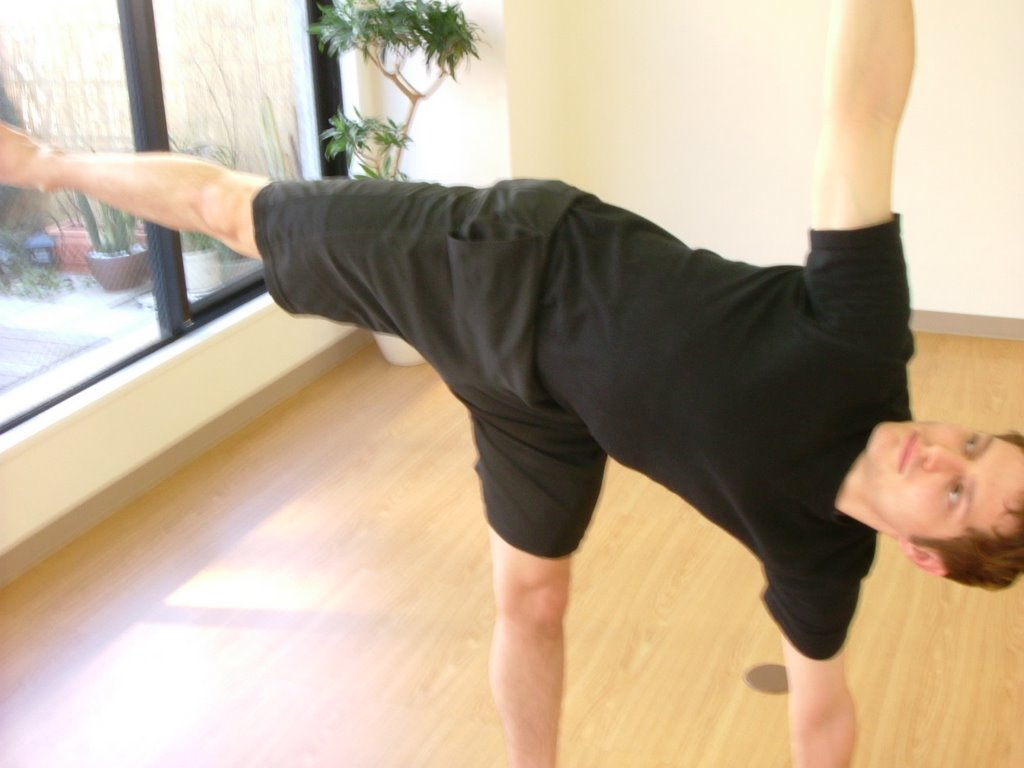
One of the lessons of yoga is to relax and accept unfamiliar situations. In half-moon pose, for example, your body weight is one hand and one leg. Your body wants to come down and touch the floor with another limb for stability, and, if you are new to the pose, that is exactly what happens. But, after a few tries, you find that relaxing, breathing, and accepting the strange position makes it much easier. If you do poses like that a few times a week, maybe your brain structure starts to change, and instead of an instinct to run away or deny strange situations, you stay with them and see where they lead.

The other thing is meditation, which teaches you to be in the moment, not clinging to the past or future. When I saw those guys my only thought was that I had to stop them in that moment. It made doing the right thing very natural and easy. Again, I want to stress that I am not a particularly good person! My reaction was just different from the other people there.

Buddhism teaches the 8 fold path as a method to overcome suffering and make your way on your spiritual journey. The 4th limb of this path is "skillful action," that is, using the energy of your actions skillfully, to bring about understanding and to do no harm. One of the nice things about meditation and yoga is that they change you on a very deep level, slowly and over time. It doesn't require much rigour, just small, daily steps. And you'll see changes in yourself, sometimes very suddenly, as I did when I was pulling that oxygen deprived business man from the bushes. So keep practicing everyone! If you like, consider it training for the time when you will need to act decisively, skillfully, and for the good of someone else.

Patrick

Yoga Garden

Monday, May 15, 2006

Making the Connection


This sign is something you can buy for your new Mustang on this web site. But it's also a sign of the times. Making physical contact with another human being is getting rarer and rarer as we wrap ourselves in layers of technology. Touching is out, unless you're talking about your Nintendo.
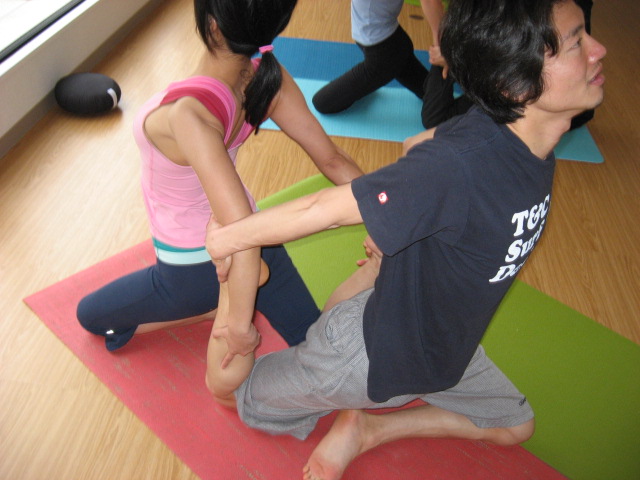
Which is why it was so refreshing to conduct and participate in the partner pose workshops we held at the studio last weekend. Partner poses use the power of two yoga practitioners to take poses deeper. But the nicest part of it for me was seeing students connect with each other.

In Japan, especially, touching someone else's body is kind of taboo. It can be hard at first to overcome the discomfort of being in close contact with someone. So one of the first exercises we did was back to back meditation, where the partners consciously try to breath together. Sitting with your back to someone's spine, feeling their back muscles and shoulders move with the breath, is a very surprising experience. Try it with someone, and you'll find yourself amazed at the sheer amount of life and vitality there can be in a single inhalation. It really drives the point home that there's another person there, with their own set of joys, fears and dreams.
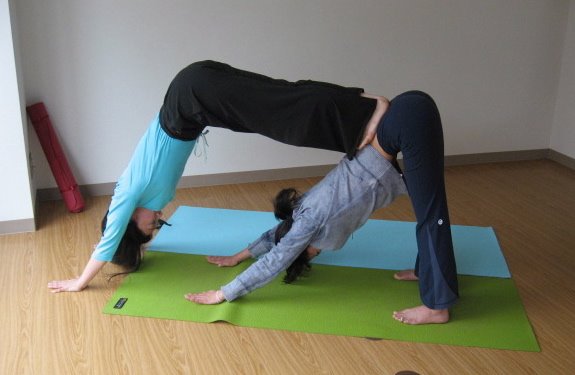
Following this and a few other "connecting" exercises, we moved into some more complicated partner asana. Many people who do yoga go very deep within themselves during a lesson, but during a partner pose you have to constantly stay focused on the balance between you and your counterpart. It really keeps you in the moment.
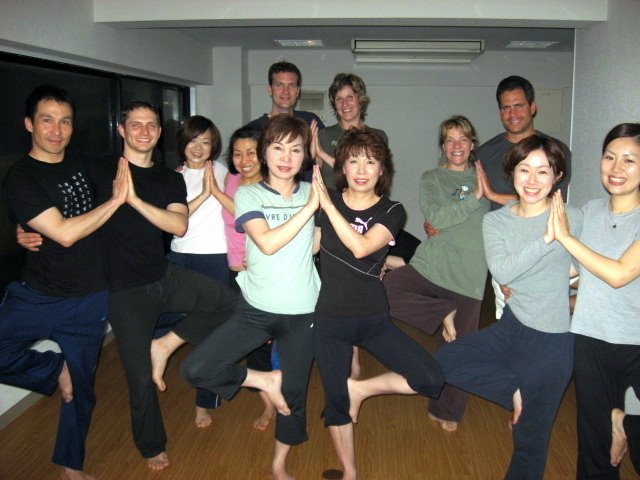
After the full session, everyone was so happy! I think the yoga had only a small part to do with this. Mostly, people were joyful to have spent some time being human. We spend everyday surrounded by concrete, glass, and plastic. But if you think about it, we share none of the qualities of those materials, we are all soft, squishy, curvy messes! And yet, our elegance shines through. Thanks to everyone who came!

Patrick

Yoga Garden

Monday, April 24, 2006

Getting to the Bottom of Sanskrit

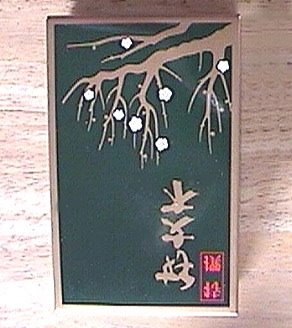
When I was going to high school in England, I had a Japanese friend named Michiko. Michiko had a really nice host family and one weekend we went over to see them. A few weeks before our visit Michiko had given them some presents from Japan wrapped in beautiful gift boxes. The family was so taken with the boxes that they had made a kind of display of them high on a shelf in the sunroom. They asked Michiko what she thought of the display and she said "It's really nice, except that they're all upside down."To the family, the elegant kanji on the box was like a pretty abstract picture, not actual writing. (I also heard a story once from someone in my Japanese class at university whose friend had the kanji for fire tattooed on his arm... it looked pretty cool, except that it too was upside down.)
I see the same thing happening sometimes with Sanskrit and yoga. First, some history.
Yoga (not just poses, but the whole philosophical system) has been around for at least 5000 years. But the yoga we are most familiar with was codified by a guy named Patanjali about 200 CE. (by the way, CE means "common era" and is the hip way to say AD) Patanjali wrote his text "The Yoga Sutras" in the academic language of the day, Sanskrit. (To learn more about the history of yoga click here)

It would be misleading of me to say that Sanskrit was a common tongue 2000 years ago. But from what I understand, in south-east asia it was the language of learning and religion, much like Latin in Europe. So Patanjali and most of the great philosophers wrote stuff down, including the names of the yoga poses, in Sanskrit.

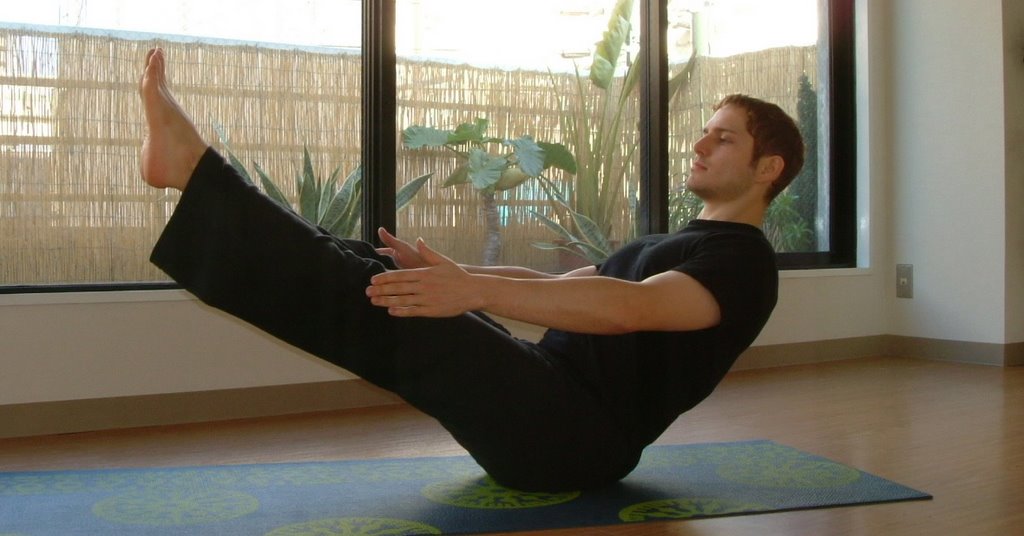
So let's take a pose with its sanskrit name, for example, Paripurna Navasana. There is something very alluring about the name in its original language, the double Ps and the silky way Navasana rolls off the tongue. It's exotic, it makes you feel like something big is happening.

But let's come back down to earth and look at the Sanskrit word for word.
paripurna means "complete" or "full"
nava means "boat" asana means "pose" or "form" (in Sanskrit, there is a complete liason between vowels, so nava asana becomes navasana)And there you have it in plain, practical, boring English... full boat pose. It's easy to get involved in the beauty of the ancient language, but we run the risk of being a little silly, like Michiko's family gazing at upside down boxes. Face it, this pose looks like a boat! And when you do it, having the image of a boat bobbing in the water really helps. (By the way, if you ask someone doing this pose what they would like to call it, they'll tell you call it whatever you want, just let it be over!)
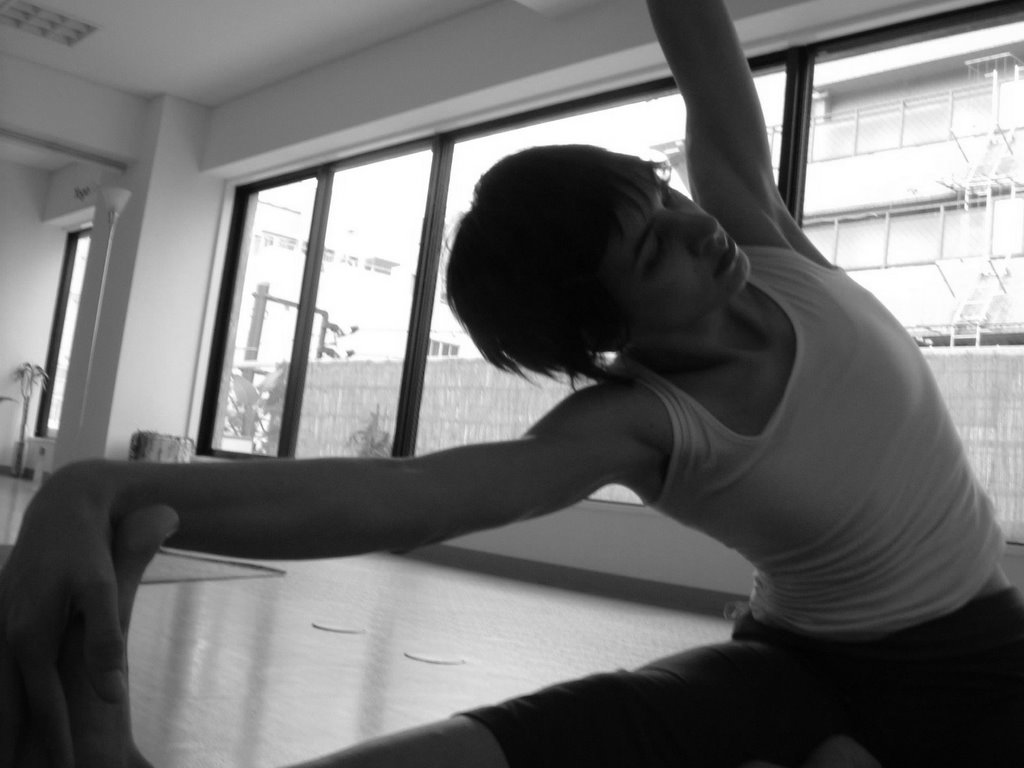
So, teaching yoga in Japan, I try to use Japanese names for the poses as much as possible, based on the original Sanskrit. I want my students to know that nothing exotic is happening during the poses, and to really get the idea of the form. Bhujangasana sounds really cool, but it won't get a student to press their hips into the mat like "Cobra Pose" will.

The person who really brought me around to this way of thinking is Thich Nhat Hanh. When we went to his retreat a few years ago there wasn't a word of Vietnamese or Pali the entire time. All the chants, songs, and meditations, except for "Om" were in English. And a lot of people there were dissapointed at how "ordinary" everything was. At the end of the retreat, if you took the 5 Mindfullness Precepts, you were given a dharma name in English. (My name is "Silent Breath of the Heart" and Gwen's is "Lovely Teacher of the Heart") One of the women in our group asked the monk "Can't you tell me my name with the Vietnamese version? I bet it's beautiful!" The monk smiled and explained that he could, but that he would not, and gave the argument that I have outlined above, that these names are to help us, not distract us. Now, years later, I still remember most of the chants from that retreat, because they were in English.

So, in yoga, by all means study and learn the Sanskrit, but don't be fooled into thinking that these foreign words make the practice any more exotic. For Patanjali these names were nothing special, they were just a way of describing the shape of the body. Like zen, yoga is nothing special, and once you accept that you'll really start going places!

Namaste (namas=I bow, te= to you!)
Patrick

Yoga Garden

Thursday, March 30, 2006

Energy Exchange

Because she's too modest to tell anyone, I wanted to note that Gwen is featured in this season's copy of Yogini magazine, and the studio got a nice write up in the back as well. Yogini comes out every three months, so check it out if you see it on the newstands.

The story they did with Gwen was a perfect fit for Yoga Garden. Gwen and one of the magazine's editors went to Chiba earlier this month and met a group of people who are trying to live more simply. The Hayashi family in particular has endeavored to live in a natural community that reduces waste and reliance on modern amenities. They live on a hilltop overlooking rice fields in a 200 year old house without air conditioning, plumbing, or electronics. They were interested in trying yoga, but there were no teachers in the area, so the editor of Yogini contacted Gwen and together they drove to the community to give them a lesson.

What's most interesting about this community to me is that they have created their own currency called "awa." They use awa between themselves and 100 or so other spots around Chiba and Tokyo that have agreed to take part in the plan. Gwen was payed 2000 awa for her yoga lesson, and she used her awa to buy lunch and some organic vegetables from the farmer on her left in the photo. You can "pay" with awa at the barber, flower shops, bookstores, and many other stores. You could also use your awa to have snow cleared from your driveway, wood chopped, or your yard maintained.
What I love about the idea of "awa" money is that it's working on a principle of direct energy exchange. Our modern monetary systems remove us several steps from this basic and life affirming feeling. We have all agreed to see money as a thing unto itself, not just paper that represents the sum of our labors. Imagine how different the world would be if we truly appreciated the energy and effort that went into getting those little pieces of paper that we throw around carelessly.

We can't all participate in an alternative currency like the Hayashis, but we can keep in mind the idea of energy exchange in our relationships. When you have a conversation with a friend, are both of you getting more of less equal energy from the dialouge? Are you giving too much energy, depleting your resources? Or taking too much, not seeing that your friend also needs to speak and share their opinions? Does your job give you as much energy (in terms of salary, free time, and happiness) as it takes from you? Anyway, something to think about and work on with small, mindful movements.

Take care!
Patrick

For more information about the awa money movement, check this site.

Wednesday, March 15, 2006

New Mats!

Hi everyone!
I've seen it a dozen times, one of our students comes into the studio and excitedly tells me they've taken the plunge and bought their own mat. "That's great," I say, ".... is this the first time you've unrolled it?" If the answer is "yes," we're in trouble.

Why? Well, in the manufacturing process, most mat companies apply a thin veneer of oil to the surface of the mats. This is to keep the mat soft and supple during the months between its production and your purchase. Mix that layer of oil with a little sweat on your palms or feet, and "downward facing dog" becomes "sliding onto your face dog." Simply put, a brand new yoga mat unrolled for the first time is very, very slippery.

What to do? A lot of people recommend putting your new mat into the washing machine with a mild detergent before using it. That will take care of the problem very quickly, but personally, I think that it makes the mats too sticky, they lose some of their organic feel. I prefer a gentler breaking in period of a few weeks. I like to lay a mat out in the sun, and simply do a lot of yoga on it. Other ideas are putting your new mat under an old one for a few sessions, going over the mat with one of those green backed sponges (using the green scrubby part). Whatever method you use, do it before the lesson so you can enjoy your new mat!

Speaking of which, many people ask me which kind of mat they should buy. Prices range from 1000 yen to 10,000 yen. We have seen really poorly designed mats for 4000 yen, and some very durable, thick mats for 1000 yen, so don't let price alone decide the matter. There are a few factors you should consider.

1. Thickness. Mats come in all kinds of thicknesses, which you will be able to compare easily in the store. If you are a little bony, you should opt for a thicker mat. Gwen uses a double thick Gaiam mat at the studio, but I use a relatively thin mat, because I like to feel the floor more during poses. Another thing to consider is that a thick mat will be harder to fit into yoga bags and (in general) be a little more difficult to travel with.

2. "Grippiness" This is the amount of friction between you and the mat. Thicker mats will offer a much stickier feel because your hand or foot actually sinks into the material. It's difficult to tell how "grippy" a mat is in the store, but you can get an idea from how raised the bumps on the surface are. The higher the bumps, the better the grip. (I once saw a really cheap mat that just had bumps painted on it, and was actually a single, slick surface) Actually, the bumpy style is going out of fashion now, and lots of rubber mats are coming out that offer superior grip. They are usually covered in a grid or squiggles. (the downside to these is that they are heavy and expensive)

3. The "it" factor. This is simply choosing a mat that you connect with. You will be spending a lot of time with it, and having some fondness for the style and color is really important. These days the choices are amazing. You can get every color in the spectrum, funky patterns, or a dragon descending down the mat. So don't just say "this one will do," make it fun, shop around, until you see a mat and say "that's IT!"

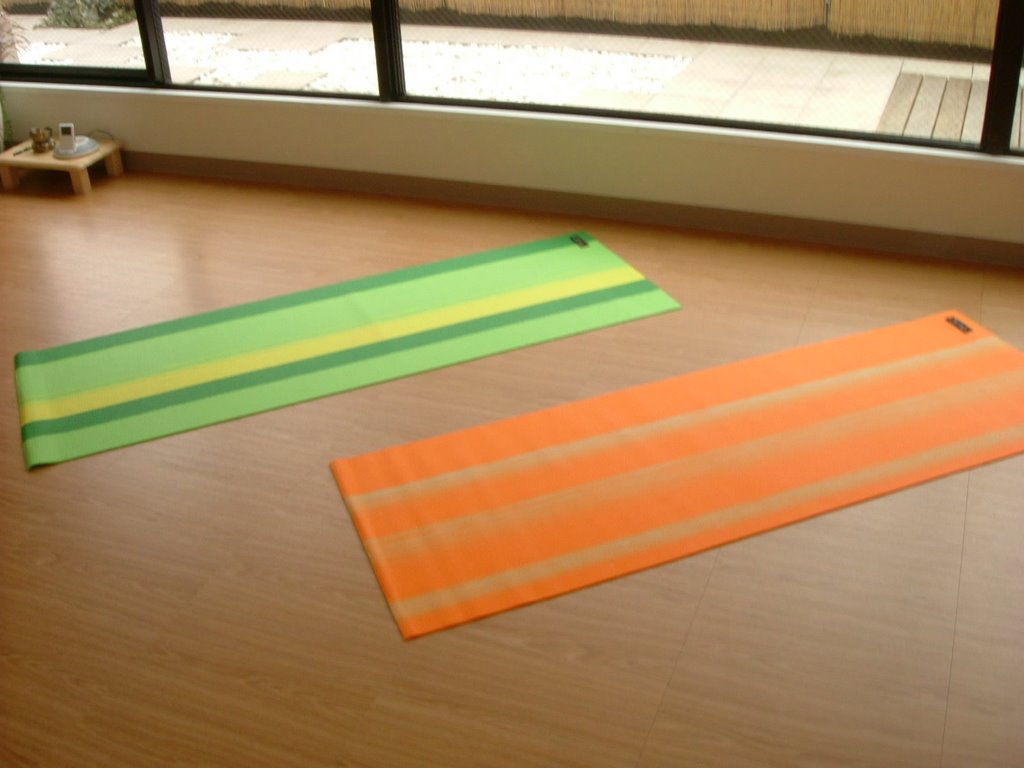
Gwen and I just got some traveling mats for the spring and summer. Bright, huh?. And thanks to Rika for getting us a good deal on them!

Patrick

Saturday, February 04, 2006

Yoga For All Seasons


The UN just released this report that says half of the world's population will be urban by 2007. Living in a city is a very disconnecting experience, especially when it comes to enjoying the change of the seasons. Moving from one climate controlled building to another (in a climate controlled car or train), hardly seeing a tree or grass, and having access to avacados and strawberries year-round, it can all make the seasons seem like a backdrop to our busy lives, nice to look at but unimportant.

But I think this is changing. This year I've heard so much in the mainstream media about Seasonal Affective Disorder. People are starting to get back to the idea that we constantly interact with and are changed by our environment.

Being sensitive to how your body is reacting to the changing seasons can also be brought into your yoga practice. During the winter, energy levels drop, muscles tighten, and circulation decreases. In yoga classes you can take notice of how your body feels at different times of the day and year. Your yoga practice can reflect the seasons, having a practice that allows the body to restore itself during the winter and burns off energy in the summer, for example, is one way to do this. Eating and resting habits, as explored in this article, should also reflect the seasons.

Relective, relaxing postures such as seated forward bends, legs up the wall, and reclining bound angle poses, all of which can be found on Yoga Journal's informative Pose Finder page, can be combined for a home practice that will allow your body to restore itself. These sorts of poses are also helpful in recovering from colds and flu.

Patrick

Yoga Garden

Saturday, January 07, 2006

Reading Between the Lines of Yoga Studies


Just before Christmas this study started popping up all over the web. I'll break it down for you. They took 101 people with back pain and divided them into three groups. One group used books to learn about back care. Another did a gym style stretching and strengthening class. And the final group did a 75 minute yoga class once a week. The yoga group decreased their pain and increased their range of movement faster than the others. Eventually, the gym style stretching group caught up with the yoga group, and the book learners didn't show much improvement.

This study can teach us several things.

First, It has been publicized as a testament to the healing power of yoga, but there is an important caveat, the fact that the stretching group caught up to the yoga group. This tells me that the most important factor here wasn't the actual movements, but the breathing. The style they used in this study was vini yoga, a very soft, slow style that uses the breath even more than a regular hatha yoga form. Breathing properly has so many benefits, I would bet that alone accounted for much of the yoga group's improvement. The change in the just the lymphatic system shows how much better your health can get with proper breathing.

Second, you'll notice this study was done by "Seattle's Group Health Cooperative Center for Health Studies" with a test pool of only 101 people. This is not a major study in any way, and yet it was leading health headlines at BBC, CNN, and Yahoo News for almost a week. This shows that there is a public hungry for scientific news related to yoga. I can count on one hand the number of serious medical investigations involving yoga that I have read about in the last few years, and they were all done by non-profit organizations such as this Seattle group. (Many were led by Dr. Dean Ornish's Preventive Medicine Research Institute)

Why so few? Well, sadly, I think the answer is that yoga isn't going to make anyone rich. The pharmaceutical companies that sponsor the "real" studies that have 1000s or 10,000s of participants aren't very interested in telling us that significant health improvements can come from an investment in a yoga mat and a few hours a week.

But that's ok, people are smart, and they don't need a study to tell them that something is working! So we'll have to trust our instincts until science catches up and tells us exactly why yoga makes us feel so good.

Patrick

Yoga Garden

Saturday, October 15, 2005

Flying with David Swenson


Last night, from 7-9:30 pm, I joined 40+ other yogis & yoginis at a studio in Shinjuku to learn about Ashtanga yoga with David Swenson. The theme of last night's class was "The Physics of Flight" and we focused on the five ingredients necessary for having an Ashtanga practice: breath, vinyasa (flow), drishti (focus), bandha (body valves) & asana (postures). Whew, when I write it out like that there's a lot going on in the body when you do yoga.
For the purpose of this post, let me just focus on one of these 'ingredients,' the breath. The breath is the thread that holds all 5 of the ingredients together. It's the one thing that, if we don't have it, we don't have a yoga practice at all. Last night David said, "the minds is more difficult to control than the wind." And from the Upanishads (sacred yoga texts), "he who has control over his breath has control over his mind." What does this mean for us when we approach the mat? Do we even need yoga in order to reign in the breath/mind? Yoga is a tool for learning to control the breath, and it takes time but eventually you can learn to inhale and exhale with the movement. That's where the idea of 'flight' comes into play. The breath allows you to glide, or flow, or fly, easily between poses.
Clearly there are other ways to flow/fly in life. You can paraglide, skateboard or race cars. Yoga is an accessible, safe way to fly. And all you need, really, is your body. And to do that one thing you've done a handful of times while reading this post: breathe.

Gwen

Yoga Garden

Thursday, September 15, 2005

Zen and Yoga


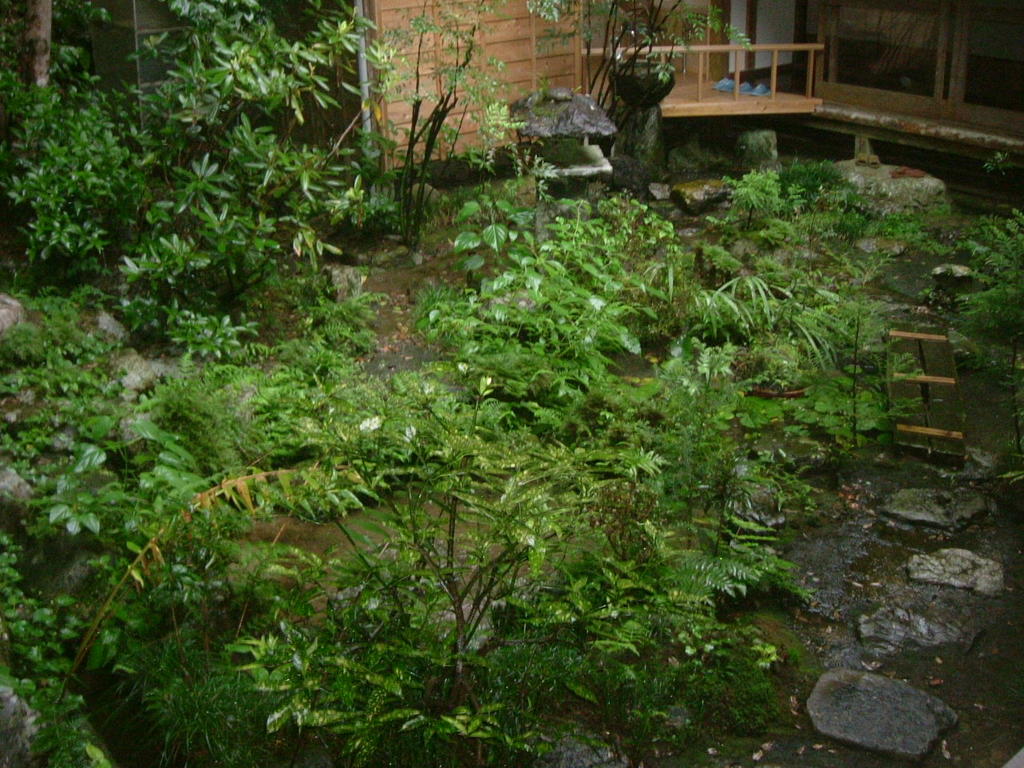
temple garden

Last week Gwen and I went to a 3 day zen retreat near Shizuoka city. It was held at a temple called Tokei-in, which is one of the places Shunryu Suzuki taught at before he went to America. I've been into zen since high school and have recently been thinking about how yoga and zen can be used together. After the session, I solidified my ideas a little more and I'll try to express them here.
How Zen and Yoga work together.

1. The basic sitting posture for zazen meditation is full or half lotus. This posture comes from the asana tradition that has been around five thousands years. So basically, Buddha was struggling to become awakened, and one of the things he remembered was this yoga pose he had done once that made him feel very stable and centered. So at their root the two practices are connected.

2. Many of our students say that one of their favorite things about yoga is that, during a pose, their thoughts drop away and they are totally in the moment. This is the same "no-mind" that zen encourages as well.

3. Back when the monks were living in the temples, they had a lot of manual labor to do during the day, which they approached with the same mindfullness as their meditation practice. So they got a daily dose of physical activity which complemented their seated meditation. But now people work in offices at desks all day, getting no physical excercise, and then go home and try to do some more sitting in zazen. I think yoga is a good substitute for the neccessary physical labors of the past. Only sitting will make your mind too squirrely, I think.

4. Sitting in zazen is physically taxing, as it requires long periods of stillness in a difficult posture. I see yoga as a perfect preparation and post-zen activity, to loosen and awaken the body.

There is a big divide in the alternative therapy world between "meditation" and "excercise." I think you need both to be as healthy as you can be. In the global age we have the chance to discover these different schools of thought, I hope we can keep finding ways that they overlap.

Patrick

Yoga Garden

Monday, August 08, 2005

Yoga in Yoyogi Park


Yesterday I went to a yoga event in Yoyogi Park, sponsored by Yoga Jaya, with special guest Louisa Sear from Australia. The event started around 9:20 in the morning, with about an hour of pranayama (breathing exercises) and meditation. About 150 people turned up. After we did meditation and breathing there was a short break followed by an hour and 15 minutes of yoga asanas (poses). Louisa led a Vinyasa Flow sequence that was challenging and sweat-inducing. Although it was hot, it was lovely doing yoga surrouned by trees, feeling the earth just under the mat, hearing the sounds of a thousand crickets all around us. After asana practice there was an informal picnic...everybody shared watermelon, orange carrot juice and salads. Yoga Jaya plans to sponsor more of these free yoga in the park events in the future...look for us there!

Gwen

Yoga Garden